Written Interview with Andreas Thomas - Windhoek Observer - 7 Feb 2012


Good afternoon Mr Louw
It seems that a new political stance has emerged were tribal sentiments and ethnicity is now at play in local politics. Tribal outburst allegedly made during the interview by Youth Minister Kazenambo against Oshiwambo speaking people and the subsequent reactions toward the comments paint a picture of a society deeply rooted tribalism in our society.
I would like to assist me answer some of pertinent questions regarding tribalism and tribal loyalties in Namibia especially in the wake of the upcoming Swapo Party congress and impact it might have on the country.
 1.      Do you think the problem of tribalism has seeped into the ruling party Swapo Party and how bad do you think that is?
Tribalism and associated decision making because of ethnic relationships had been a product of the Apartheid South African ruling system. This we have to accept. However, we as a nation have committed ourselves to another standard, whereby through reconciliation and the adoption of our constitution, we do not base decision-making on culture or tribal affiliation.

Having said that though, we must realise that politicians present things in certain ways to get themselves elected. Look at our opposition parties and all have an ethnic (though some say locality) representation.

Swapo, being the party representing the largest protion of the population, would obvisouly thus also constitute the largest section of Oshiwambo speaking people. From a representative viewpoint, thus also many of the leaders of SWAPO would also be of this cultural group.

However, tribalism is not the problem. I believe the problem is rather nepotism - (patronage or favoritism shown on the basis of extended family relationships) and cronyism (partiality to long-standing friends, especially by appointing them to positions of authority, regardless of their qualifications).

If however, the person seeing this act nepotism is only seeing it in tribal terms, as they themselves are not part of that specific tribe.

So no, tribalism is not the problem, nepotism and cronyism are.


 2.     Government adopted the policy of National Recompilation mainly to achieve reconciliation between blacks and white Namibians. Since independence, it has increasingly become evident that there is a tension between the various ethnic groups in Namibia. Should reconciliation between black Namibians therefore not had been the first priority after independence and is there not a need even now to start a process of reconciliation between various ethnic groups?  

Please allow me to explain a little - Reconciliation can be used in terms of either

  • conflict resolution or
  • ethnic relations 


Thus Namibian reconciliation as Independence was conflict resolution between two ideological opposing sides. The one side, wanting Namibia to be a part of South Africa as a fifth province, and the other side wanting independence from South Africa. Thus conflict resolution reconciliation has been effective.

What we are seeing is that there is a need for ethnic resolution reconciliation.

So no, it could not have been a first priority. But it is still a step we need to take as a nation. We need to create a common memory - a history lesson we all feel comfortable with which explains where we all come from, why we came here, and what our shared future vision is.

I would like to see our leaders rather promoting our differences, and what we can learn from each other, than what has been reportedly said my the Minister.

I believe this quote explains what I mean, "..But maybe memory is what young people need to be taught before they can be taught actual history."


 3.     Minister Kazenambo feel that he is being victimised because of the calls he made for the next country President (Swapo) to be non-Oshiwambo. But how would you suggest Minister Kazenambo should have handled this matter during the interview?

I cannot say how the Minister should or should not handle any matter. However, if any reporter should ask me how i feel as a coloured person, I would immediately state that I believe in in integration. By this I refer to the lump sum off all of us as citizens of a specific country. It is the pride we have when singing the national anthem, our support to the members of our national sporting codes, or identifying with a Namibian that has done well on the world stage.

The best way to illustrate this is: "Before Independence I was Coloured, now I'm Namibian".


 4.     Having a current situation of politics based on the premise of “now it is the turn of other tribes to take over". What do you think the impact this will be on politics in the country and society in general? Do you expect tribal loyalty take centre stage at the congress?

First, if it is "the turn of others" to take over - it should be the turn of a Namibian woman to be President. Or do we as a nation, or political party, or as families, not yet believe woman are as good (or even) better as leaders?

I wish to state that there is more gender-based discrimination among Namibian men than what there is tribal-based discrimination.


The issues of leading Swapo, or Namibia will always be what is best for us as a nation. Each and everyone must vote according to their conscience. We deserve the leaders we choose.

Nevertheless, we must face the reality that whoever is elected to be in command of SWAPO after Comrade Pohamba will be the next President of Namibia. So yes, it will have an impact on our society if the person chosen is not the best candidate, but rather the "best oshiwambo" candidate.

During the last congress when Hidipo Hamutenya, Nahas Angula and Hifikepunye Pohamba stood as candidates, it is clear that the Swapo members chose the person who in the long run has been the best choice for us as a arty, and Namibia as a nation

Will tribal loyalty take centre stage - yes in the form of cronyism. All political parties in the world are based on give and take within the voting process - who is my friend, who will do something for me. However, terming it tribalism is just another way to hide from the fact that in Namibia too many of us still do not believe we are "One Namibia, One Nation".

We are a tribe, the Namibian tribe.

Culture, racism and tribalism


My rambling thoughst about race, tribalism and the recent tribal based comments by KK and others

Namibia and Integration
Most of the Namibian peoples have come to this area leaving behind war or oppression of some sort or the other. They chose this inhospitable place to settle and live peacefully, not only with one another, but also with the natural environment they found themselves in. During periods of oppression they have not had a choice but to react to ensure their continued peace and stability.


After Independence, it was only natural that Namibians should choose to have one of the best constitutions in the world that ensures this peace and continued peaceful co-existence with one another. The policy of reconciliation was as natural for its people as breathing and eating.


Today, Namibia is a model that few other countries can emulate. Worldwide, countries struggle with problems of integration. These differences take the form of religion, language, customs or race. In Namibia these differences are recognised, but do not form the basis of either government policy decisions or social interaction.


As Namibians we have a lot to offer the world, and more specifically our neighbours in Southern Africa. We are an “Institute of Integration” where peoples from other parts of the world can come to learn what we know – we have a dependency on our fellow human beings and the natural environment in which we stay.


Differences in Namibia
We have thrown the baby out with the bathwater. This is the only explanation of the total lack of information based on cultural affiliations in our census in Namibia. Unfortunately, this attitude of “let’s pretend it is not there” does not make it so.


Even in South Africa, where the Apartheid system was the most formalised, they have recognised the need to keep the information and knowledge of all cultural groups as part of the “rainbow nation”. Discrimination because of race colour or culture is a thing of the past and is replaced by recognition and acceptance of our differences.


We have also outlawed discrimination on the basis of gender, yet still need this categorisation to measure the needed changes that must take place in our country for gender equality. In the same way it is important to note that when a previously marginalised group, such as the San people, have qualified teachers from within their own tribe and culture (Republikein – 14 April 2009).


The lack of recognition of certain groups can have detrimental effects on our country. Look at what has happened to some of our pre-Independence orphans who returned from East Germany. More recently we have seen the SWAPO veterans and orphans also wishing to be recognised as a distinct group with specific needs. In the near future we will see a new group forming of AIDS orphans who have grown up differently with specific disadvantages that need to be addressed to allow them to fully pluck the fruits of our freedom. What culture shall all these groups inherit?


There is a national culture Namibia. Thus we can refer to our language as Namlish with its peculiarities and pronunciations. We are known by our friends and foes on the sport fields as the Brave warriors and the Biltongboere.


In business we refer to the marketing process. It starts with an analysis of the present and then moves to develop a strategy. In marketing it is recognised that to provide the best product for the customer you need to segment the market. Tools such as the Living Standards Measurement are used to focus our marketing efforts. A typical LSM would include age, gender, race or cultural group and income. (Living Standards Measurement Study (LSMS) household surveys have become an important tool in measuring and understanding poverty in developing countries.)


The people of Namibia are the customer. To serve our people better we must recognise our difference not only in gender or language but also in race. The census in Namibia must measure the race and culture embraced by each resident in future.


The tertiary education institutes in Namibia must then participate in research focussing on cultural, racial, gender, urban-rural economic and livelihood inequalities in Namibia. This ongoing research must continue to ask what the relationship is between the growth and spatial distribution of the public and private economic sectors. It must also encompass the formal and informal economy, the nature of poverty, the characteristics of poor areas, and socio-economic empowerment.

I am a socio-political entrepreneur

I often consider myself a socio-political entrepreneur. To me this means that while I chase a business objective, i also need align certain political / legal frameworks to enable me to reach my longer term goals.

Perhaps they just express it a little to harshly for my ego.


Architects of the Future: The Socio-Political Entrepreneurship Style of 5GW

PurpleSlog. "Architects of the Future: The Socio-Political Entrepreneurship Style of 5GW." PurpleSlog. August 27, 2007. http://purpleslog.wordpress.com/2007/08/27/architects-of-the-future-the-socio-political-entrepanuership-style-of-5gw/ (accessed January 14, 2011).
In the second blog post of a series of blog posts exploring potential archetypes, or styles, of 5GW, PurpleSlog suggests a “Socio-Political Entrepreneurship” style of 5GW.

Unlike the first archetype explored in the series (“The Puppet Master”), the Socio-Political Entrepreneurs will operate in the open to effect large-scale changes but their exact motives and ultimate goals will be hidden from view; that is,

The S-P-E 5GWer acts out in the open (not in secret), but their true aims or expected/hoped-for consequences are closely held (secret) and/or at longer timespans than most folks consider or notice (there’s the secrecy), or the effects are so broad/horizontal that the ramifications are overlooked by most.

The Socio-Political Entrepreneur will operate across many domains, with and/or upon a wide variety of other actors, through visible means, but his apparent goals will be seen as the normal goals of entrepreneurship of one sort or another while his real motivations and goals remain hidden. PurpleSlog gives a short list of examples, although these are given as metaphors and not necessarily as examples of real Socio-Political Entrepreneur 5GW effectors:

  • Super-empowered money actors (think Gates, Buffet, Soros)
  • Super-empowered media access actors (think Gore, Michael Moore, Kos)
  • Super-empowered idea/meme generating actors
Furthermore, many apparatuses such as NGOs or even Dan Abbott’s “Military-Industrial-Sysadmin Complex (MISC)” or other force structures or public organizations could conceivably operate as Socio-Political Entrepreneur 5GW organizations.

Architects of the Future: The Socio-Political Entrepreneurship Style of 5GW - 5GW Theory Timeline

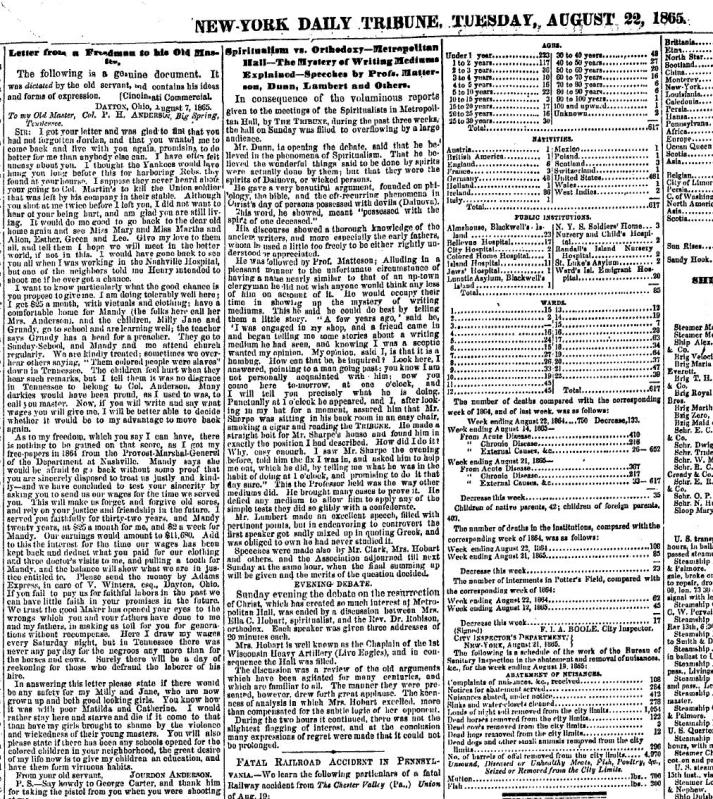
To my old slave master


Dayton, Ohio,
August 7, 1865
To My Old Master, Colonel P.H. Anderson, Big Spring, Tennessee

Sir: I got your letter, and was glad to find that you had not forgotten Jourdon, and that you wanted me to come back and live with you again, promising to do better for me than anybody else can. I have often felt uneasy about you. I thought the Yankees would have hung you long before this, for harboring Rebs they found at your house. I suppose they never heard about your going to Colonel Martin's to kill the Union soldier that was left by his company in their stable. Although you shot at me twice before I left you, I did not want to hear of your being hurt, and am glad you are still living. It would do me good to go back to the dear old home again, and see Miss Mary and Miss Martha and Allen, Esther, Green, and Lee. Give my love to them all, and tell them I hope we will meet in the better world, if not in this. I would have gone back to see you all when I was working in the Nashville Hospital, but one of the neighbors told me that Henry intended to shoot me if he ever got a chance.

I want to know particularly what the good chance is you propose to give me. I am doing tolerably well here. I get twenty-five dollars a month, with victuals and clothing; have a comfortable home for Mandy,—the folks call her Mrs. Anderson,—and the children—Milly, Jane, and Grundy—go to school and are learning well. The teacher says Grundy has a head for a preacher. They go to Sunday school, and Mandy and me attend church regularly. We are kindly treated. Sometimes we overhear others saying, "Them colored people were slaves" down in Tennessee. The children feel hurt when they hear such remarks; but I tell them it was no disgrace in Tennessee to belong to Colonel Anderson. Many darkeys would have been proud, as I used to be, to call you master. Now if you will write and say what wages you will give me, I will be better able to decide whether it would be to my advantage to move back again.

As to my freedom, which you say I can have, there is nothing to be gained on that score, as I got my free papers in 1864 from the Provost-Marshal-General of the Department of Nashville. Mandy says she would be afraid to go back without some proof that you were disposed to treat us justly and kindly; and we have concluded to test your sincerity by asking you to send us our wages for the time we served you. This will make us forget and forgive old scores, and rely on your justice and friendship in the future. I served you faithfully for thirty-two years, and Mandy twenty years. At twenty-five dollars a month for me, and two dollars a week for Mandy, our earnings would amount to eleven thousand six hundred and eighty dollars. Add to this the interest for the time our wages have been kept back, and deduct what you paid for our clothing, and three doctor's visits to me, and pulling a tooth for Mandy, and the balance will show what we are in justice entitled to. Please send the money by Adams's Express, in care of V. Winters, Esq., Dayton, Ohio. If you fail to pay us for faithful labors in the past, we can have little faith in your promises in the future. We trust the good Maker has opened your eyes to the wrongs which you and your fathers have done to me and my fathers, in making us toil for you for generations without recompense. Here I draw my wages every Saturday night; but in Tennessee there was never any pay-day for the negroes any more than for the horses and cows. Surely there will be a day of reckoning for those who defraud the laborer of his hire.

In answering this letter, please state if there would be any safety for my Milly and Jane, who are now grown up, and both good-looking girls. You know how it was with poor Matilda and Catherine. I would rather stay here and starve—and die, if it come to that—than have my girls brought to shame by the violence and wickedness of their young masters. You will also please state if there has been any schools opened for the colored children in your neighborhood. The great desire of my life now is to give my children an education, and have them form virtuous habits.

Say howdy to George Carter, and thank him for taking the pistol from you when you were shooting at me.

From your old servant,
Jourdon Anderson.


_________________________________________________________________________________________
In the summer of 1865, a former slave by the name of Jourdan Anderson sent a letter to his former master. And 147 years later, the document reads as richly as it must have back then.

The roughly 800-word letter, which has resurfaced via various blogs, websites, Twitter and Facebook, is a response to a missive from Colonel P.H. Anderson, Jourdan's former master back in Big Spring, Tennessee. Apparently, Col. Anderson had written Jourdan asking him to come on back to the big house to work.

In a tone that could be described either as "impressively measured" or "the deadest of deadpan comedy," the former slave, in the most genteel manner, basically tells the old slave master to kiss his rear end. He laments his being shot at by Col. Anderson when he fled slavery, the mistreatment of his children and that there "was never pay-day for the Negroes any more than for the horses and cows."

 To take a look at what appears to be a scan of the original letter, which appeared in an August 22, 1865 edition of the New York Daily Tribune, click below:


From:
http://www.huffingtonpost.com/2012/02/01/in-recently-discovered-le_n_1247288.html?ncid=edlinkusaolp00000009

Why use words like black market?


Black and white in language was not used to refer to the colour of people's skin.

"....there were no “white” people in Europe before 1492. With the transatlantic slave trade, first Indian, then African, Europeans increasingly saw “white” as a race and race as an important human characteristic."

Before this period, black referred to things that could be done under cover of darkness.

Sorry friends, there is nothing racial about black market, etc.

Namibian Blog list 2012

A list of Namibian bloggers which I hope to expand with your help.


Thanks

Financial education counselling: counsellor's handbook


The Financial education counselling: counsellor's handbook is a resource for consumer advocates looking to provide free financial education.  The handbook provides practical advice in a way that non-experts can understand and convey.

The Counsellor's Handbook is divided into a number of topic sections, including savings, budgeting, and debt management. It also contains take-home activities that can be given to consumers, as well as activity ideas for counselling sessions.

http://www.consumersinternational.org/media/897062/ci%20financial%20education%20counselling%20handbook%20final.pdf

Oh, the Places You'll Go!

by Dr. Seuss


Congratulations!
Today is your day.
You're off to Great Places!
You're off and away!

You have brains in your head.
You have feet in your shoes.
You can steer yourself
any direction you choose.
You're on your own. And you know what you know.
And YOU are the guy who'll decide where to go.

You'll look up and down streets. Look 'em over with care.
About some you will say, "I don't choose to go there."
With your head full of brains and your shoes full of feet,
you're too smart to go down any not-so-good street.

And you may not find any
you'll want to go down.
In that case, of course,
you'll head straight out of town.

It's opener there
in the wide open air.

Out there things can happen
and frequently do
to people as brainy
and footsy as you.

And then things start to happen,
don't worry. Don't stew.
Just go right along.
You'll start happening too.

OH!
THE PLACES YOU'LL GO!

You'll be on y our way up!
You'll be seeing great sights!
You'll join the high fliers
who soar to high heights.

You won't lag behind, because you'll have the speed.
You'll pass the whole gang and you'll soon take the lead.
Wherever you fly, you'll be best of the best.
Wherever you go, you will top all the rest.

Except when you don't.
Because, sometimes, you won't.

I'm sorry to say so
but, sadly, it's true
that Bang-ups
and Hang-ups
can happen to you.

You can get all hung up
in a prickle-ly perch.
And your gang will fly on.
You'll be left in a Lurch.

You'll come down from the Lurch
with an unpleasant bump.
And the chances are, then,
that you'll be in a Slump.

And when you're in a Slump,
you're not in for much fun.
Un-slumping yourself
is not easily done.

You will come to a place where the streets are not marked.
Some windows are lighted. But mostly they're darked.
A place you could sprain both your elbow and chin!
Do you dare to stay out? Do you dare to go in?
How much can you lose? How much can you win?

And IF you go in, should you turn left or right...
or right-and-three-quarters? Or, maybe, not quite?
Or go around back and sneak in from behind?
Simple it's not, I'm afraid you will find,
for a mind-maker-upper to make up his mind.

You can get so confused
that you'll start in to race
down long wiggled roads at a break-necking pace
and grind on for miles cross weirdish wild space,
headed, I fear, toward a most useless place.
The Waiting Place...

...for people just waiting.
Waiting for a train to go
or a bus to come, or a plane to go
or the mail to come, or the rain to go
or the phone to ring, or the snow to snow
or the waiting around for a Yes or No
or waiting for their hair to grow.
Everyone is just waiting.

Waiting for the fish to bite
or waiting for the wind to fly a kite
or waiting around for Friday night
or waiting, perhaps, for their Uncle Jake
or a pot to boil, or a Better Break
or a string of pearls, or a pair of pants
or a wig with curls, or Another Chance.
Everyone is just waiting.

NO!
That's not for you!

Somehow you'll escape
all that waiting and staying
You'll find the bright places
where Boom Bands are playing.

With banner flip-flapping,
once more you'll ride high!
Ready for anything under the sky.
Ready because you're that kind of a guy!

Oh, the places you'll go! There is fun to be done!
There are points to be scored. There are games to be won.
And the magical things you can do with that ball
will make you the winning-est winner of all.
Fame! You'll be as famous as famous can be,
with the whole wide world watching you win on TV.

Except when they don't
Because, sometimes they won't.

I'm afraid that some times
you'll play lonely games too.
Games you can't win
'cause you'll play against you.

All Alone!
Whether you like it or not,
Alone will be something
you'll be quite a lot.

And when you're alone, there's a very good chance
you'll meet things that scare you right out of your pants.
There are some, down the road between hither and yon,
that can scare you so much you won't want to go on.

But on you will go
though the weather be foul.
On you will go
though your enemies prowl.
On you will go
though the Hakken-Kraks howl.
Onward up many
a frightening creek,
though your arms may get sore
and your sneakers may leak.

On and on you will hike,
And I know you'll hike far
and face up to your problems
whatever they are.

You'll get mixed up, of course,
as you already know.
You'll get mixed up
with many strange birds as you go.
So be sure when you step.
Step with care and great tact
and remember that Life's
a Great Balancing Act.
Just never foget to be dexterous and deft.
And never mix up your right foot with your left.

And will you succeed?
Yes! You will, indeed!
(98 and 3/4 percent guaranteed.)

KID, YOU'LL MOVE MOUNTAINS!

So...
be your name Buxbaum or Bixby or Bray
or Mordecai Ali Van Allen O'Shea,
You're off the Great Places!
Today is your day!
Your mountain is waiting.
So...get on your way!

A quote on attitude

"The longer I live, the more I realize the impact of attitude on life.

Attitude, to me, is more important than facts. It is more important than the past, than education, than money, than circumstances, than failures, than successes, than what other people think or say or do. It is more important than appearance, giftedness or skill. It will make or break a company... a church... a home.

The remarkable thing is we have a choice every day regarding the attitude we will embrace for that day. We cannot change our past... we cannot change the fact that people will act in a certain way. We cannot change the inevitable. The only thing we can do is play on the one string we have, and that is our attitude... I am convinced that life is 10% what happens to me and 90% how I react to it.

And so it is with you... we are in charge of our attitudes."

Dr Seuss - my best friend

http://www.youtube.com/watch?feature=player_embedded&v=ahv_1IS7SiE


This morning I was inspired by a friend's post on the last Dr. Seuss book, Burning Man.

Dr Seuss was one of those sets of books that I can still return to time and time again, and find new pearls of wisdom. The first time I read one of his books it was at the Von Welligh Library in Johannesburg. This was 1976, I had just lost my mother and my father seemed to have abandoned us children.

My grandparents had taken us in and were trying their best to give us a better life. This included moving to Darragh House, the flats belonging to the Anglican Church, in Hillbrow, Johannesburg, South Africa. This was one of the few "grey areas" in Johannesburg where light skinned coloureds could hope to start a life as "whites".

Thus at the age of six, I was stuck in a small flat, not able to make friends with the neighbours, and missin my parents.

That's when I discovered "The Cat in the Hat". In Dr Seuss I had a new friend who still whispers in my ear:

"Today you are You, that is truer than true. There is no one alive who is Youer than You."


(Thanks Dave Duarte ;-)
The whole book can be watched at: http://www.youtube.com/watch?feature=player_embedded&v=ahv_1IS7SiE


Children's books available electronically -when can we give them e-readers?


See: Project Gutenberg Children's collection


"African publishers lag in shift to electronic books
Electronic readers are transforming the way people enjoy their books. However, there is very little African published content on the online stores. For a reader looking for a Kenyan book or literature published in Africa, one has to get the ink-and-paper version as few publishers have moved online."

There are programs in place to provide one-laptop-per-child and the latest is getting e-readers to children. One of these is an organisation called Worldreader.org. What is the possibility of Namibia recognising this as a future trend and start planning for it.

I recently completed together with an international team, a study for the University of Washington on "Libraries, Telecenters and Cybercafés: A Comparison of Different Types of Public Access Venues".

It is sad that we neglecting our children's access - I just look at the example of our public library in Windhoek.

Worldreader aims to put a library of books in the hands of families worldwide, using e-reader technology.

Literacy depends on access to written material. E-readers can deliver written material anywhere, quickly and easily. But there is little known about the effect these devices have in classroom settings or in developing countries.

Worldreader.org completed several classroom trials using e-readers to explore the use of digital content in the developing world.

Our working hypotheses are that:


  • E-readers will increase access to books due to lower distribution costs and immediate visibility of millions of books available online.
  • This will result in a larger number and greater variety of books read, and increased excitement and exchange of ideas around these books.
  • The result will be a higher value placed on reading within the classroom, family, and community.
  • The results will be specific and measurable, and will, in the long term, increase literacy and opportunity for those involved.


Management coaching: There’s method in the madness | Africa Report

Management coaching: There’s method in the madness | Africa Report

It’s time to tackle the dreaded M word –management. With management coaching, this has never been easier.

By Craig Falck for Africa Report

Managers are not born… They are trained. And mentored. And coached. Management coaching is a new technique that’s gaining popularity around the world because it gives employees the skills they need when they enter higher management positions. After all, these programs are popular for a reason…

Being a manager is more than just delegating and having a “manager” sign on your business card, desk or office door. It’s about being able to handle the company, to mould and develop your team and department, and lead the team to victory. And that’s where management coaches come in. Like any coach in a sport, they will instil certain principles and knowledge in their leader and coach them to be the best that they can be. There are so many things that managers need to know these days and so many tools that they have at their disposal – there’s nothing that they can’t do in the workplace. Unless, of course, they haven’t had the proper training and coaching.
Management coaching is all about identifying your inner manager traits and learning how to use them. We’re talking communication skills that allow you to better communicate your needs and wants in the office; decision making that puts the power in your hands to quickly decide what needs to be done and what can be ignored; concentration that allows you to focus on your goal and make sure that you get there no matter what obstacles stand in your way; drive and determination that you can pass onto others to encourage them to meet their objectives; insight, discretion and understanding that will give you the tools to cope with the office dynamics and personal issues that arise, and a number of other character traits that make for a good manager and leader.
The thing is, as popular as manager coaching is, there are still those that scoff at the idea and call it “foolish” and “mad”. However, these names come from two kinds of people: those who think they know it all, and those who know nothing. You cannot simply slam a form of education or knowledge sharing because you don’t agree with it or because it’s not to your liking. Knowledge is power, and any form of education should be appreciated and exploited. The more you know, the better equipped you will be to handle what your workplace throws at you.
Huddle up, team… it’s time to coach your management skills and turn you from also-ran-boss to game winner in the blink of an eye.

Andreas Guibeb - Experimenting with education in Namibia

Andreas Guibeb
The poor outcome of the matric results of the past year takes me back down memory lane when I had the good fortune to serve as assistant teacher (hulp onderwyser) for a Grade9 class at Ella Du Plessis for a brief period.

I soon realized the huge gap in performances between the top and lowest performing students, especially those who commuted daily from Katatura to attend school in Khomasdal in the hope of a better future. I refused to accept that some kids were stupid whilst others were clever. My challenge was to proof that theory by narrowing that gap. But how...?

Not prejudiced by the dogma of formal teacher training I experimented a lot and tested the tolerance limits of the school principal by abolishing the system of giving individual test marks and replacing it with a test mark for each student equal to the class average test mark for the subject. So every pupil in the class had either a good or horrible test mark for each subject. My point was that the success of everyone in the class was and should be our collective concern. We will only achieve that objective if we all start sharing good studying and learning strategies with everyone and increase the class average by helping the poor performers to up their contribution to the average class performances. I said let's all fake it till we make it and achieve the highest possible average class result, which means that everybody is doing well individually.

I therefore paired pupils to do homework and prepare for tests and taking particular care to pair top performers with under performers. I did this intuitively and without any knowledge of "positive deviancy theory" developed years later by Harvard Professor Jerry and Monique Sternin. With hindsight it reasures me that there was sense to the experiments of the scientist gone mad in the Ella du Plessis School laboratory.

This initiative was however very disturbing (understatement) to the school principal, school administration, the top performers and their parents in the class. The underlying spirit of: "We are in this together and we win when everyone wins" that I was trying to share, militated against the acquired wisdom pervasive in all aspects of our life of: "Each one for him/herself and God help us all". 

So I convened a meeting of parents, the school principle, students and myself where I explained that if the top performers and poor performers studied together both will win. When both win everyone wins. The top performers would gain lifelong friends and the poor performers gained a window into the thinking and study methods of top performers. The poor performers would gain self-esteem they lacked before when they see improved results. Once successful, they will dislike failure forever.

I am greatful to the school principal, parents and pupils for having allowed me to continue that risky experiment, but the rest is history as they say. 
Though I spend only a few months with the class all of them passed matric and gained access to university long after I left the school. The empowering lesson. If allowed, challenged and supported by all stakeholders the learners themselves will come up with more resourcefull and efficient solutions to the most chalenging situations. Because they come up with the solution themselves, it sets them on a lifelong course of success.

I am gratefull to the star pupils of my class at Ella du Plessis who took the exercise to heart and help under performers acquire better study habits and thus raised the test average for all. 

As Shakespeare says,"when the tide rises all boats are lifted". No top performer became worse because of helping others but all under performers became star pupils and realized their full potential. This is literally and figuratively true in all fields of life as today proven by the "positive deviancy theory".

Roux-che Locke: teachers who were part of my life's journey: thank you


This is gonna be quite a lengthy piece, so - you are under no obligation to view my status...Anyway,I went to register my Gr. 5 son at his school this week when "Mother-Nature" called... a little boy directs me to the nearest girls'-restroom, and it is here that I am greeted by those smaaaaaaaalllllll miniature toilet-pots - first thought: would my "African-booty" fit on this? But now Mother-Nature is really calling, and I dont' have much of a choice! So, I sit down - as in reaaaaaalllly sit down, in fact, it felt more like I was doing a failed sit-up attempt - knees almost touching my chin: that's how low!! Anyway, I am immediately taken back to almost 30 yrs ago when I started my first school day: Sub A, M.H Greeff Prim: 2 netjies gekamde-bees-gelekte laaaaaaaaaannng vlegseltjies net soos ma dit kon doen, "dressed-2-kill" in my blou skool-rokkie wat so byna onder die knie stop en 2 stokkies-beentjies wat net-net uitsteek (ogh, how I hated this look!!), en my bruin "suitcasey" lekker ge-stock met ma se "bederf" vir die dag...my teacher, Mrs. Strauss (the most beautiful and elegant teacher, and today "aunty Maureen" to me...) Dis hier waar ek my eerste tree na die res van my "shaping-en-moulding" gee, waar ek my karakter ontdek en verder create...Maar wat ek eintlik wil se is dat dit hier is - op hierdie miniature-toiletjie (en neeeeeee, dit was nie so lank wat ek gesit het nie...lol!) dat ek besef watter noble job dit is om onderwyser te wees... So, to aaaaaaaaallllll my teachers who were part of my life's journey: thank you for your valued contribution to who and what I am today. And to my child(ren)'s teachers and those-to-be: thank you for the contribution and impact you will make in his (their) life! En nou is dit tyd om op te staan van hierdie klein miniatuur potjie, want my bene en booty kan dit nie meer hou nie!!

Tyd loop uit vir inspraak in kommunikasiewet


6.07.2007

Tyd loop uit vir inspraak in kommunikasiewet

ROLSPELERS in die telekommunikasiebedryf en ander belangstellendes het nog net tot Dinsdag om insette te lewer oor voorgestelde wysigings aan die land se langverwagte nuwe kommunikasiewet.
Die Namibiese Kommunikasiekommissie (NCC) sal slegs tot 10 Julie bykomende kommentaar ontvang oor 'n konsepwet wat die grondslag vir die volledige liberalisering van die telkommark sal lê.
'n Nasionale slypskool sal vanaf 25 tot 27 Julie plaasvind om finaal vorm aan 'n wet te gee wat deur 'n ewekansige geleentheid vir vrye en gesonde mededinging uiteindelik vir Jan Alleman onder meer die beste moontlike diens en pryse moet verseker.
Die wet sal die NCC ook vervang met 'n veel gevaarliker waghond, die Namibiese Kommunikasieowerheid (NCA).
Die Kabinet het in Maart vanjaar midde 'n hete geveg tussen Telecom, MTC en Cell One oor of die staatsvoorsiener die mobiele foonmark met sy nuwe produk Switch kon betree, hierdie wetgewing wat al agt jaar in aantog is, op die sneltrajek geskuif. Behalwe dat Telecom opdrag gegee is om Switch-kliënte se opvangs intussen tot die dorp waar hulle woon te beperk, is bevel gegee dat die nuwe kommunikasiewet reeds vandeesmaand in die Nasionale Vergadering moet dien.
Hierdie tydvenster is reeds gemis. Ná finalisering sal die wet ook eers weer voor die Kabinet moet dien.
Die Inligtings- en Kommunikasietegnologie-alliansie (ICTA) is 'n forum wie se lede by laat vandeesmaand se finale indaba oor die kommunikasiewet hul stemme na verwagting baie dik kan maak. Volgens mnr. Milton Louw wat die Alliansie bestuur, is daar die volgende twee maande nog twee baie belangrike byeenkomste.
Op 2 en 3 Augustus sal IKT-beleid in die visier inskuif, terwyl 'n konferensie op 13 September halsstarrige probleme met die administrasie van Namibië se domeinnaam op die internet (.na) gaan takel. As deel van die nasionale besit is dit volgens mnr. Louw noodsaaklik dat die land se internetkode in nasionale belang bestuur moet word.
Die ICTA wie se nuusbrief 'n omsendsyfer van byna 1 400 het, het volgens mnr. Louw nuwe lewe gekry ná 'n lang sluimerperiode en verwag om hul individue ledetal, wat verlede jaar op 10 gestaan het, tot in die omgewing van 80 te vermeerder. 'n Totaal van 54 sakeondernemings was verlede jaar deel van hierdie belange- en drukgroep. 
Enigiemand met navrae oor die werk van dié Alliansie is welkom om mnr. Louw by 081 304 3282 te skakel, of hom by milton@iit.com.na te vonkpos. Hul webwerf is www. ictalliance.org.na.
Voorleggings oor die huidige konsepkommunikasiewet, beskikbaar by die NCC (061 222 666), moet in elektroniese en gedrukte formaat wees (vyf afskrifte van elke voorstel is nodig) en dit moet die Kommissie op die laatste teen 10 Julie bereik. Hul kantore is by Robert Mugaberylaan 56.
Die NCC sal na verwagting eersdaags die konsultante aanwys wat aan die spits van die finalisering van die wet sal staan.

Nuwe bedeling vir 'dot com dot na'


DEELNEMERS aan 'n onlangse beraad oor die administrasie van Namibië se domeinnaam op die web, "dot na", het hulself bankvas geskaar agter die noodsaak vir 'n stelsel wat hierdie nasionale bate op 'n veel doeltreffender wyse sal bestuur.
Klagtes oor 'n "diktatoriale, diskriminerende en disfunksionele" status quo - waaroor koppe al vir jare baie hard stamp - het die Alliansie vir Inligtings- en Kommunikasietegnologie (ICTA) genoop om rolspelers bymekaar te roep om 'n padkaart vir ingrypende verandering op te stel.
Volgens mnr. Milton Louw van ICTA sal die eenparige steun wat by hierdie slypskool vir vernuwing gemonster is, die weg baan vir 'n formele aansoek van regeringskant aan die internasionale Internetkorporasie vir Toegedeelde Name en Nommers (ICANN) dat die registrateurskap vir ".na" uit die hande van dr. Eberhard Lisse geneem word. Lede van die alliansie dink dit is hoog tyd om die sterk persoonlike angel uit 'n rompslompstryd te trek wat volgens mnr. Louw veroorsaak dat meer as 70 persent van nuwe webwerwe wat vandag in Namibië geregistreer word, net die "dot com"-naam eerder as Namibië se eie, unieke webkode dra.
Hy het dr. Lisse se bewering dat hy nie genooi is om sy saak te stel nie verwerp.
Volgens mnr. Louw het mnr. Sackey Shanghala, die persoonlike raadgewer van die Minister van Justisie en Prokureur-generaal, me. Pendukeni Iivula-Ithana, wat aan die stuur van die finalisering van die land se lank verwagte nuwe wet oor inligting en kommunikasie staan, verseker dat die administrasie van Namibië se domeinnaam vervat sal word in hierdie konsepwet, wat volgens plan nog in die huidige sitting van die parlement ter tafel gelê sal word.
Die voorstel is dat die nuwe kommunikasie-owerheid (NCA), wat deur hierdie wet in die lewe geroep sal word, 'n onafhanklike liggaam sal stig wat die administrasie, registrasie en regulering van "dot na" sal hanteer tot 'n wet op elektroniese transaksies ingestel is. Die plan is dat die publiek lede uit die IKT-bedryf, regslui, akademici en burgerlikes sal nomineer om op hierdie raad te dien.
Die beter diens waarop almal in die proses aandring, kan egter nog jare neem om 'n werklikheid te word.
Terwyl 'n mens volgens mnr. Louw met 'n kredietkaart op die internet binne vyf minute vir sowat N$90 'n nuwe webwerf kan registreer as die kliënt tevrede is met net 'n "dot com", wag aansoekers weke om 'n "dot na"-naam te kry. Dít kos N$565.
Volgens ICANN se reëls word die eerste persoon wat 'n werf met 'n land se toegedeelde kode registreer, outomaties die registrateur. Dr. Lisse het in 1990 op hierdie manier beheer oor die bestuur van "dot na" gekry, wat tans deur die onderneming Ondis en die Namibian Network Information Centre (NA-NiC) op Swakopmund behartig word.
So 'n registrateur kan die prosedure vir die registrasie van nuwe werwe vasstel en aansoeke goed- of afkeur.
Ontevredenes meen heeltemal te veel mag het in die proses in 'n enkele internetman se hande beland.

Namibië moet digitaal verspring

http://www.republikein.com.na/die-mark/namibi-moet-digitaal-verspring.94007.php


25.09.2009

Namibië moet digitaal verspring

NAMIBIË kort blykbaar ’n dringende ingryping in die inligting- en kommunikasietegnologie (IKT) sektor om die steeds groeiende gaping tussen globale tegnologiese vordering en nasionale ontwikkeling te oorbrug. 

Volgens mnr. Milton Louw, skrywer van Smile my Beloved Land, sal sy IKT-aksiegroep bewusmaking in Namibië hoog op die nasionale agenda plaas. Mnr. Louw het onlangs die IKT aksiegroep gestig om Namibiërs aan te spoor om so gou moontlik deel van die digitale rewolusie te word. 

Die aksiegroep wil die Regering as vennoot betrek om op elke vlak bewusmaking te beklemtoon en om die regeringsmandaat te verkry om die publiek oor IKT in te lig. 

Die IKT-aksiegroep wil graag ’n sentrale register in Namibië begin, plaaslike webtuistes help skep en onderhou en mense aanmoedig om by webtuistes sooswww.namlish.com, wat ’n digitale gemeenskap Namibiërs bymekaarbring, aan te sluit en landgenote aan te spoor om ’n digitale nasionale identiteit te skep. 

Mnr. Louw noem dat volslae IKT-infrastruktuur dit moontlik maak om ’n moderne inligtingsamelewing en kennisekonomie te kan aandryf, wat blyk die tendens is wat presterende lande volg. 

Hy noem dat Facebook, in terme van lede, reeds die wêreld se vyfde grootste “land” sou wees. Hy vermeld ook hoe die akteur Ashton Kutcher vir CNN in ’n weddenskap geklop het dat hy ’n miljoen kontakte op Twitter kon kry. 

Hy noem dat veral in lande soos Namibië, Nigerië en Suid-Afrika ’n reusesprong in selfoon-tegnologie plaasgevind het, wat ’n hele ander mark vir IKT-bewusmaking open. ’n Onlangse studie toon dat 80% van die Namibiese bevolking ’n selfoon het, maar net 3.7% gebruik ’n rekenaar met internettoegang. 

“Armoede is dus nie net ’n konsep wat met geld en basiese infrastruktuur verduidelik kan word nie, maar ook deur ’n gebrek aan kennis oor en toegang tot relevante inligtingen kommunikasietegnologie,” sê mnr. Louw.

Hein Scholtz

Urbanomics: A Public Credit Registry for India?

Urbanomics: A Public Credit Registry for India?


One of the fundamental challenges with any credit market is the asymmetry in information between borrowers and lenders. This generates markets failures arising from adverse selection (of borrowers) and moral hazard (among borrowers).

Inadequate information about credit risks posed by borrowers was a significant contributor to the sub-prime mortgage crisis in the US. Blinded by the spectacular rise in property prices and perverse institutional incentives, coupled with absence of adequate information about borrowers, mortgage lenders threw caution to the wind and indulged in a lending spree.

Closer home, one of the major complaints against micro-finance institutions (MFIs) is the widespread trend of multiple borrowings by poor people. Though unaware of the credit histories of their borrowers, MFI lenders were carried away by the belief in their ability to recover loans and gave loans without proper due diligence. The result was poor people saddled with multiple loans from different MFIs, with atleast some of them being merely used to reschedule or repay older loans.

In this context, a credit history register assumes great importance. Credit reporting systems (CRS) are a widely accepted means to capture current and historical lending and payment information on individual borrowers. Such CRS's enable lenders to accurately assess credit risks and monitor the riskiness of their loan portfolios. The CRS databases are also used by regulators to more effectively monitor and supervise banks and ensure financial stability. In this respect, CRS's form the backbone of a healthy credit market.

At a time when banks do not hold monopoly of credit, and are even being eclipsed by other players, it is important that such credit registries cover the transactions of these institutions. The MFIs are just but one of these large number of lending institutions that dot the credit marketplace. Finally, CRS's will enable effective implementation of the recommendations of the International Regulatory Framework for Banks (Basel III).

The Credit Information Bureau (India) Ltd (CIBIL), owned by a consortium of banks and financial institutions, is the first and leading credit registry in India. It collects and disseminates the applicant's complete credit record that may be spread over different institutions. It provides information about the credit history of commercial and consumer borrowers to only its members. However, its membership and access is strictly on payment basis.

In many respects, such CRS is a classic public good. The social benefit of maintaining a CRS out-weighs its private benefit and cost. Further, fragmented credit bureaus defeat the very purpose of establishing them. A single universal credit registry will generate network effects and attract more institutions. Only governments have the incentives to maintain such registries.

An appropriately structured Public Credit Registry (PCR) can be invaluable in the assessment of credit risks and will enhance banking and financial market supervision. There are many countries with PCRs, run by their central banks or banking regulators.

The troubles faced by the MFIs is a clear indication about the need to have in place a Public Credit Registry of India, where all financial institutions register and share information about their borrowers. The Aadhar number provides an excellent anchor around which credit histories can be located and traced.

Cry The Beloved Country

From the Namibian newspaper 13 January 2012

PEOPLE no longer become ashamed or show sympathy in this country, it seems. They only get angry and aggressive when caught out or when dubious deals are questioned.
Some are so brazen they tell critics to leave them in peace in order to make their money. “It’s not my fault you don’t want to be in business,” is one refrain. “You are just jealous,” is the more common one. The details of the incidents exposed by the media are ignored as even the masses buy into the defence that journalists and other critics are simply envious because young blacks are becoming ‘empowered’ and getting rich in the process.
Two such incidents provided this newspaper with ample fodder for ‘hard news’ over the holiday season, a time generally viewed as a ‘soft news’ period. Seemingly the officials in the Ministry of Agriculture, Water and Forestry and the Ministry of Works and Transport regard the reporting and questioning of two tenders as either an irritant or unnecessary and unjustifiable.
Both contracts were discussed and decided just before Christmas, a time when the country literally shuts down for more than a month. And they were regarded as ‘too urgent’ to wait for proper procedure. The agriculture ministry’s Permanent Secretary Andrew Ndishishi pushed through a decision to award a dam construction project to an Italian company called Impregilo at a cost of N$2,8 billion – a good N$800 million more than the lowest bid from a Chinese company also considered suitably qualified.
The Minister of Works and Transport, Erkki Nghimtina, is also said to have insisted that only one company be considered in a N$150 million emergency contract to repair a decrepit railway line. Despite the Tender Board telling the works ministry to find at least two competitors, it came as no surprise that the ministry claims it could find no one else ‘open for business’ except the company it had hand-picked.
The government officials find nothing wrong with the fact that they or their friends own those companies which get government tenders, as is the case with the Permanent Secretary in the Office of the President, Dr Ndeutala Angolo, whose Schoemans Office Systems supplied State House equipment.
It is probably unfair to people like Angolo to mention names because the incestuous government-business relationships have become so commonplace that it is understandable if apparent do-gooders like President Hifikepunye Pohamba and Prime Minister Nahas Angula begin to despair.
It already appears that the general population have resigned themselves to aspects which in many societies would be frowned upon as dubious deals and corrupt systems.
In fact, the situation is so bad there are many Namibians who wish former President Sam Nujoma was back in power, because, they argue, at least under him corruption was ‘well managed’ or at least restricted to a few. This is despite the fact that Nujoma’s mere presence remains the cause of the paralysis that has gripped those he left in charge of the ruling party and the government.
Cry beloved Namibia, cry.

More Than N$200 Million Is Waiting. The Question Is: Will You Claim What Is Yours?

For years I have spent my time tracing people. Not criminals. Not missing persons. People who are owed money. Sometimes it is an insuranc...